
Two years ago I was the guy who thought yoga mat prices were a scam. Twenty bucks at TJ Maxx, done. Then I went through four more mats trying to fix problems with the cheap one, spent more money total, and ended up understanding exactly why people pay $90 for rubber and fabric.
Here’s what I actually found — including a $20 mat that’s genuinely worth buying.
Why Cheap Yoga Mats Fail (The Real Reason)
Cheap yoga mats are made from PVC foam. It’s a perfectly reasonable material for occasional use. But PVC has a specific failure mode that nobody warns you about: it gets slippery as you heat it up.
The first five minutes of practice on a $20 PVC mat, your hands stay put. By minute fifteen, when you’re generating body heat and there’s moisture on your skin, your palms start to slip during downward dog. You adjust your stance, lose focus on the pose, get frustrated.
You then spend the next thirty minutes doing mental math about whether you need mat gloves or a mat towel or just a different mat.
Compare that to natural rubber — what the Jade and Manduka PRO Black mats are made from. Natural rubber grips better when it’s damp. Not perfectly, but significantly better. The texture on a rubber mat is almost tacky when you press down with intention.
That one difference explains most of the price gap.
The $20 Option That Actually Works: BalanceFrom GoYoga
I’m going to lead with this because I don’t want someone who does yoga twice a month to spend $90.
The BalanceFrom GoYoga runs about $20–25 on Amazon. It’s a 1/2-inch thick PVC mat with a textured surface and double-sided non-slip fabric backing.
What it does well: It’s thick. At half an inch, your knees and hips get real cushioning. For beginners who spend a lot of time in tabletop, child’s pose, and kneeling lunges, that extra padding actually matters. The price means you’re not stressing about it getting scuffed or leaving it at the gym.
The honest tradeoff: After about 20 minutes of active flow, it gets slidey. For restorative yoga, yoga nidra, or any practice that’s mostly floor-based and calm — this mat is legitimately great. For vinyasa or hot yoga where you’re moving fast and sweating, you’ll notice it.
I still have this mat. I use it for stretching in the morning when I don’t want to bother with my good mat.
Best for: Beginners, casual practitioners, anyone doing restorative or yin yoga, people who want something for stretching and light movement.
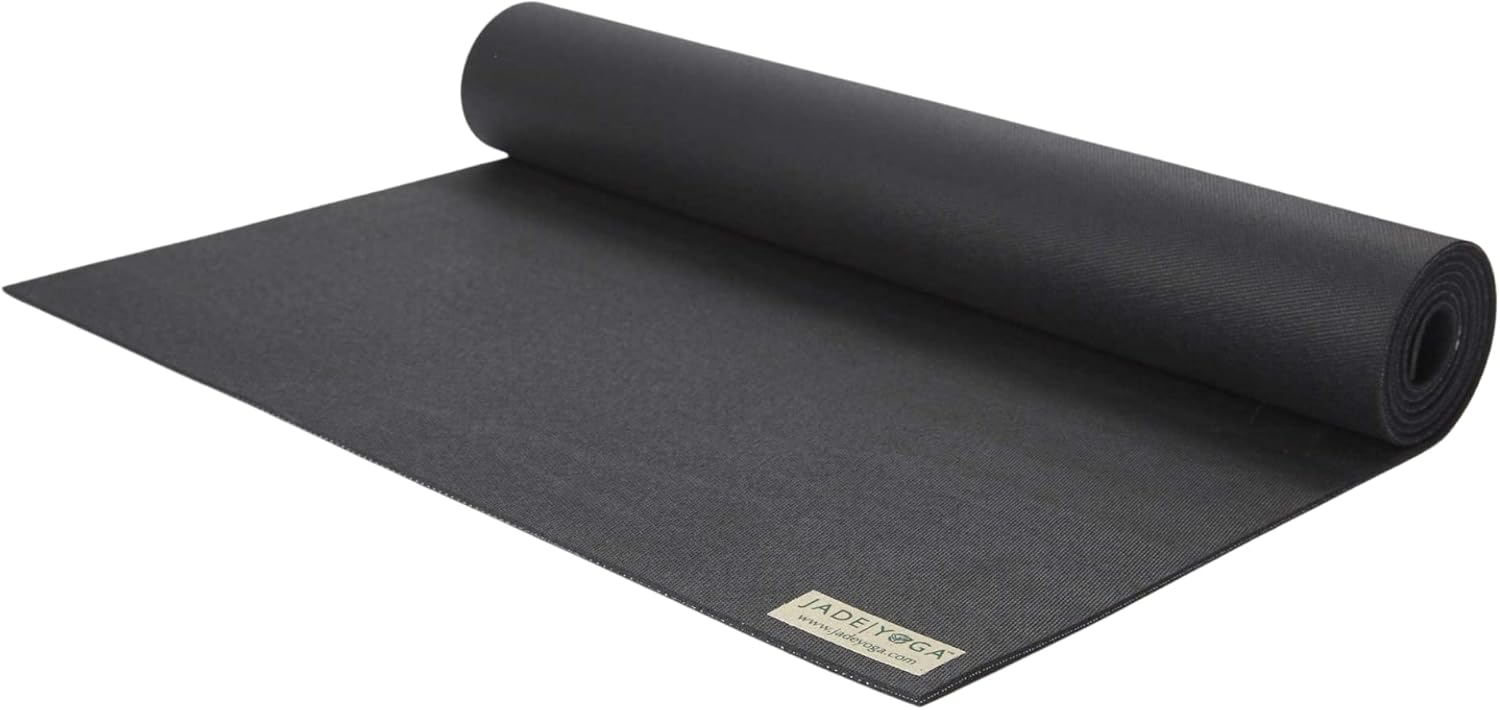
What Changed My Mind: JadeYoga Harmony
I bought the JadeYoga Harmony after a friend left hers at my place for a weekend and I realized my mat had been making my practice harder.
The grip difference is legitimately startling. In downward dog with my palms planted, I could push into the ground and my hands stayed exactly where I put them. Not slightly. Not mostly. Exactly.
Natural rubber has a different texture — almost slightly sticky rather than smooth-with-texture. When you push down, the mat pushes back. You can feel the resistance.
The smell: Real talk — new JadeYoga mats have a strong rubber smell. Not offensive, but definitely present. It fades over a few weeks with regular use. Rolling it out near a window helped. If you’re extremely sensitive to smells, this is worth knowing.
The weight: At 5.4 lbs, the Harmony is heavier than a PVC mat. This matters if you’re carrying it to a studio. In a backpack it’s fine. Slung over a shoulder for half a mile, it gets annoying.
How long does it last: I’ve had mine for two years. There’s minimal compression in the rubber. No peeling, no flaking, no areas where the texture has worn smooth. My BalanceFrom mat started pilling at high-friction spots after about a year.
Best for: Anyone who practices 3+ times a week, people doing vinyasa or hot yoga, anyone who’s been frustrated by slipping.
The Lululemon Answer: Reversible Mat ($88)
I tested this for six weeks after buying it on sale. The Lululemon Reversible Mat at $88 is made from natural rubber on one side, polyurethane on the other.
The polyurethane side grips extremely well — better than the Jade in direct comparison, actually. The rubber side feels more like a standard mat.
The catch: Polyurethane is delicate. Multiple yoga teachers I’ve talked to warned that PU-top mats need careful cleaning. Hot water or too much cleaning product degrades the surface. The grip gets worse over time in a way that rubber doesn’t.
After six months of regular use, my sample had lost some of that initial tackiness. The JadeYoga hasn’t.
Who it’s actually for: If you love a super-grippy feel right out of the box and you’re ok with it slowly getting less grippy, the Lululemon is worth it. If you want consistent grip that holds up over years, go rubber.
The Premium Option: Manduka PRO ($120–$135)
The Manduka PRO is the mat yoga teachers buy. Dense closed-cell natural rubber, lifetime guarantee, virtually no compression over years of use.
It’s 6mm thick — noticeably more cushioned than the Jade at 4.7mm. For people with knee or hip issues, that extra 1.3mm makes a real difference.
The break-in period is real. The Manduka PRO is less grippy than the Jade for the first 5–10 uses. Manduka sells a special salt scrub to help. After break-in, the grip is exceptional.
At $120+, you’re spending on permanence. People genuinely use these for a decade.
Best for: Serious practitioners, yoga teachers, anyone who wants to buy once and never think about it again.
What About Lululemon The Mat ($98)?
Different product from the Reversible Mat. The Mat uses a different rubber formulation. Similar story — excellent initial grip, requires careful maintenance.
At $98 versus $90 for JadeYoga, I’d take the Jade. The JadeYoga’s natural rubber is more forgiving and consistent over time.
Quick Comparison
| Mat | Price | Material | Thickness | Grip (Dry) | Grip (Sweaty) | Lasts |
|---|---|---|---|---|---|---|
| BalanceFrom GoYoga | ~$22 | PVC | 6mm | ★★★ | ★★ | 1–2 yrs |
| JadeYoga Harmony | ~$90 | Natural rubber | 4.7mm | ★★★★★ | ★★★★★ | 5+ yrs |
| Lululemon Reversible | ~$88 | Rubber/PU | 5mm | ★★★★★ | ★★★★ | 2–3 yrs |
| Manduka PRO | ~$128 | Natural rubber | 6mm | ★★★★ | ★★★★★ | 10+ yrs |
What I Actually Recommend
For most people: JadeYoga Harmony. The grip holds up whether you’re six weeks in or six years in. Sustainable materials. The tree-planting program isn’t marketing — JadeYoga has been doing it since 2000.
On a tight budget: BalanceFrom GoYoga. Not ashamed of this recommendation. It does the job for casual practice and costs less than a single yoga class.
If you want the absolute best: Manduka PRO. Get the salt scrub. Use it for the next decade.
The mat I use for every practice, the one that never gives me a reason to think about grip: it’s the Jade. Two years in and I haven’t considered replacing it.
That’s the actual answer.