
Everyone recommends the same two kitchen scales. Go read any “best kitchen scale” article right now — Wirecutter, Serious Eats, Bon Appétit, whatever — and you’ll see the OXO Good Grips 11-Pound and the Escali Primo on literally every single one. They’ve been recommending these same two scales since like 2019 and nobody seems to question it.
And look, they’re not bad scales. But heres the thing that bugs me. Most of those reviewers are testing accuracy with calibration weights and checking if the display is readable. They’re not actually baking with them for weeks. They’re not trying to measure 3 grams of instant yeast at 6am when you’re half asleep and your sourdough schedule is already behind.
I am though. Because I ruined two consecutive batches of macarons last October and it turned out my “good enough” scale was rounding my almond flour measurements by up to 4 grams each time. Four grams doesn’t sound like much until you realize thats the difference between perfect shells and sad cracked cookies that stick to the parchment paper.
So We bought four scales over the next two months and actually baked with all of them. Bread, macarons, pizza dough, pastry. Not a calibration weight test — real flour-everywhere, sticky-hands, 5am-feeding-my-starter kind of testing.
“Do I actually need a kitchen scale for baking?”
Yes. Full stop.
We know measuring cups exist. We used them for years. But a cup of flour can weigh anywhere from 120 to 160 grams depending on how you scoop it. That’s a 33% variance. Imagine if your gas pump was 33% inaccurate — you’d lose your mind.
Every professional baker weighs ingredients. Every serious recipe lists weights. If you’re still scooping flour with a measuring cup you’re basically guessing and hoping. It works fine for cookies and banana bread. It does not work for macarons, croissants, sourdough, or anything where ratios actually matter.
The four scales We tested
We spent about $135 total on these. Used each one for at least two weeks of regular baking.
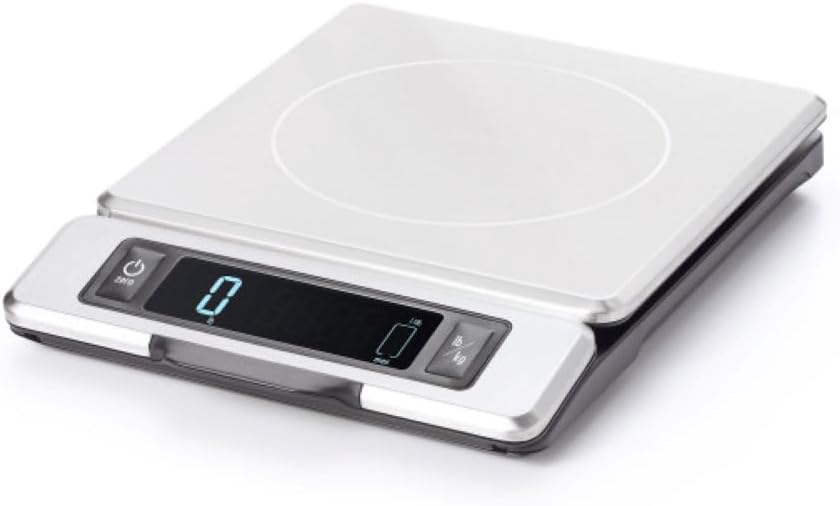
OXO Good Grips 11-Pound Scale — ~$50. The one everyone recommends. Pull-out display, stainless steel platform, measures in 1g increments.
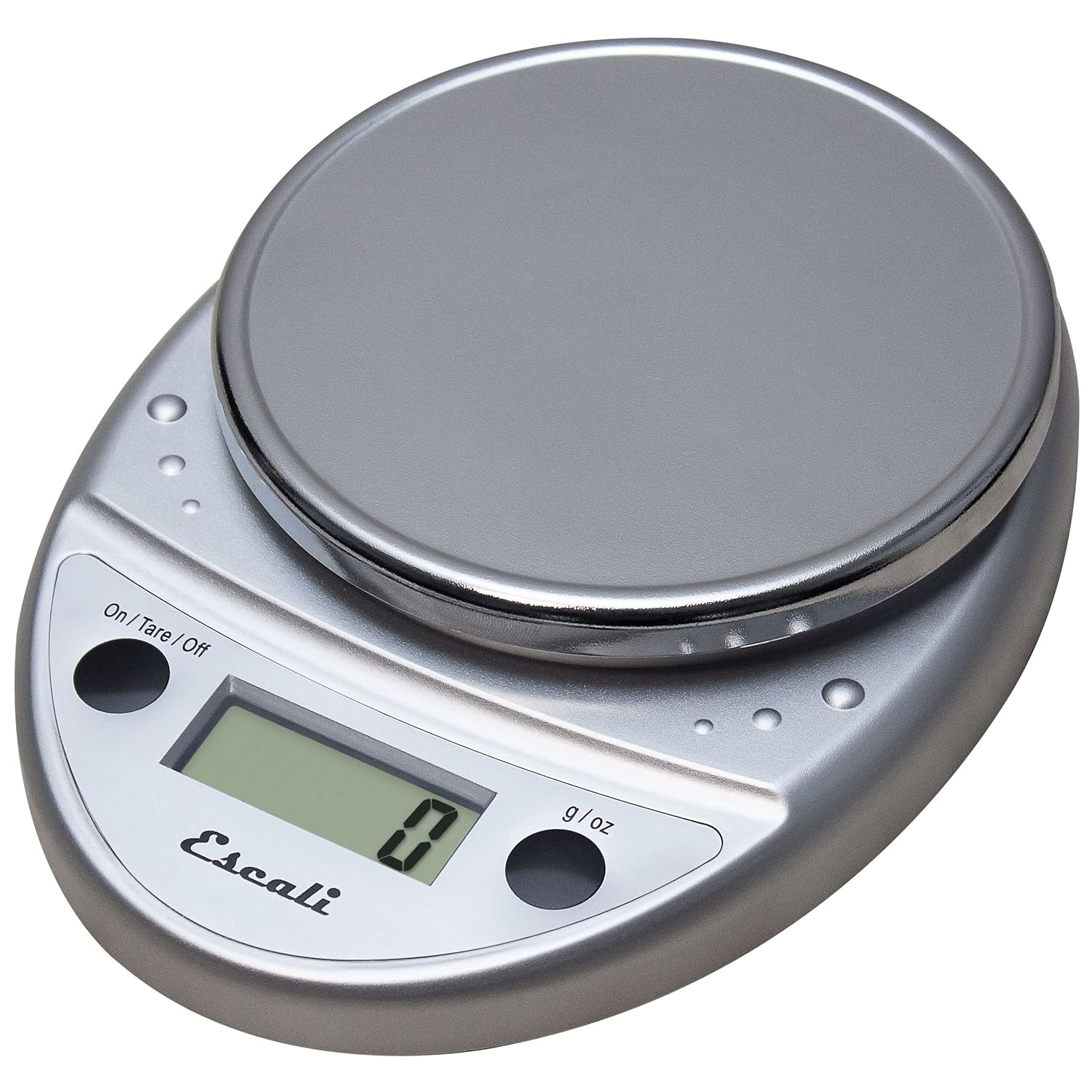
Escali Primo — ~$26. The budget pick on every list. Simple two-button design, 11-pound capacity, 1g increments. Comes in a bunch of colors.
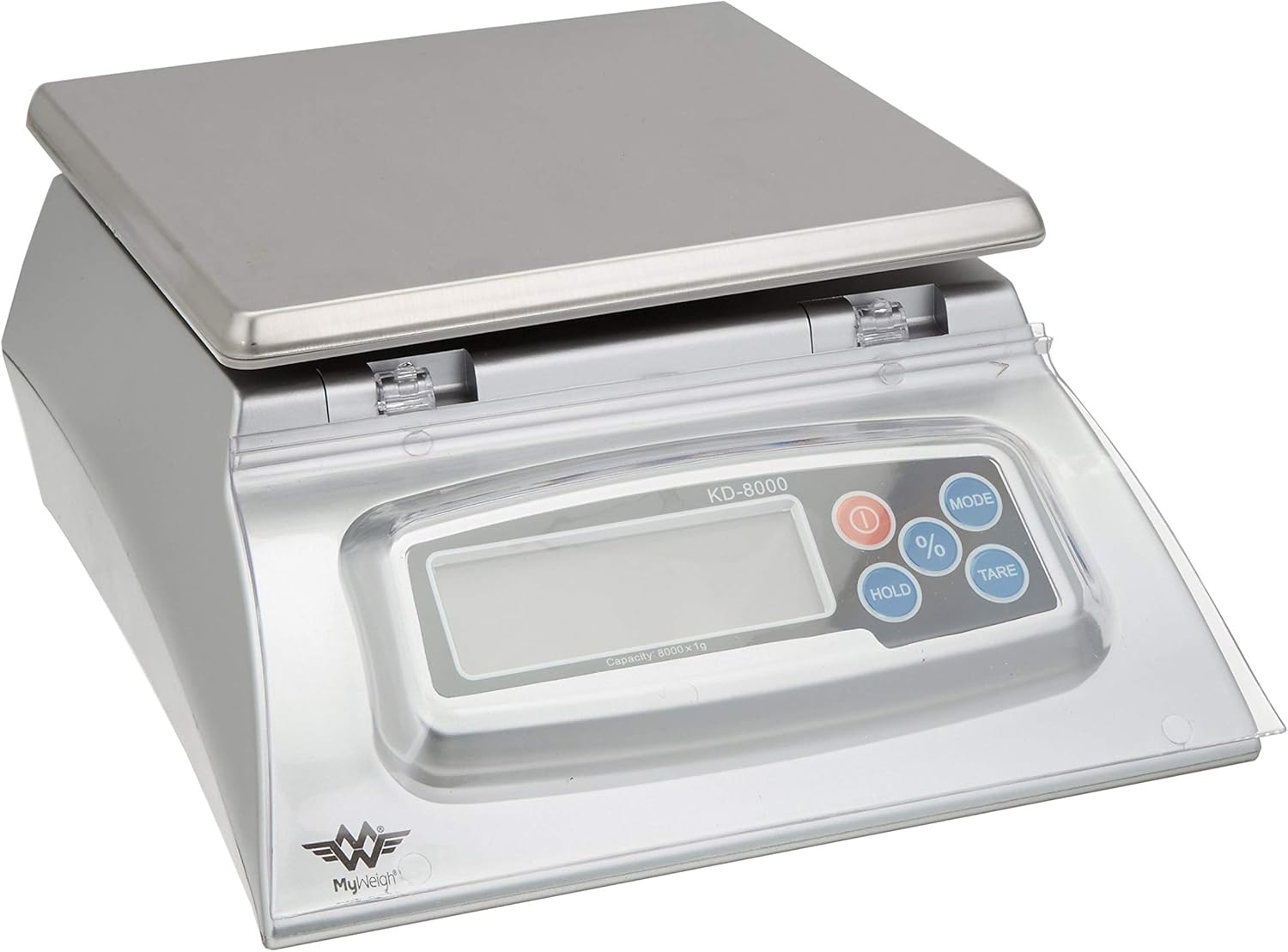
MyWeigh KD-8000 — ~$45. The one bread bakers obsess over. Has a baker’s percentage mode, 8kg capacity, and a splash guard over the display. Not pretty but very functional.
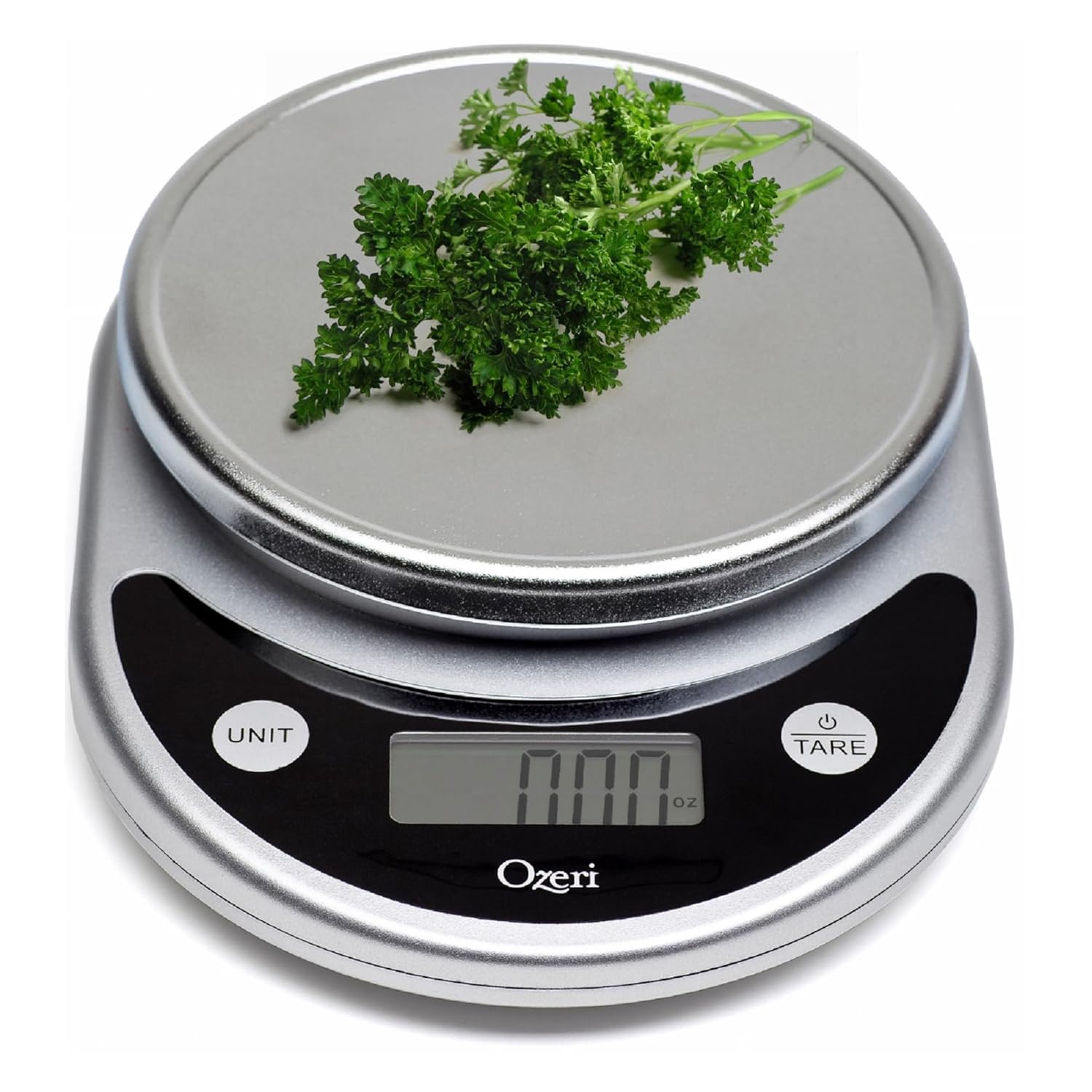
Ozeri Pronto — ~$12. The ultra-budget pick. Over 15,000 reviews on Amazon, mostly positive. 1g increments, basic but cheap.
“Which one is most accurate?”
This is where it gets interesting. For weighing like 500g of flour? They’re all fine. Basically identical. I weighed a bag of King Arthur bread flour on all four and got readings within 2g of each other. No complaints.
But small measurements — thats where things fall apart. We tried measuring 3g of salt on each scale by slowly adding pinches. The Escali and Ozeri would sit at “0” and then suddenly jump to “2” and then “4.” They couldn’t register the tiny incremental changes. The OXO was slightly better but still rounded weirdly below 5g.
The KD-8000 was the only one that consistently picked up 1g additions from the start. Adam Ragusea did a video about this exact problem — your scale shows “3g” but you might actually have 4 or 5 grams on there because it’s been rounding up each tiny addition to zero before suddenly jumping. For baking soda, yeast, salt… that matters.
“Is the OXO worth $50?”
Honestly? For most people cooking dinner, sure. The pull-out display is genuinely nice when you’ve got a big mixing bowl on top — you can actually see the numbers without craning your neck. And the 15-minute standby mode is clutch because other scales shut off after like 2 minutes while you’re in the middle of measuring stuff.
But for $50 you’re mostly paying for the OXO brand and that pull-out display gimmick. The accuracy at small weights isnt any better than the $26 Escali. And it only goes to 11 pounds which sounds like enough until you’re making a triple batch of sourdough and your bowl plus flour is pushing 12 pounds.
We use it as my “cooking scale” for weighing chicken breasts and pasta portions. Its great for that. Not my first choice for baking though.
“What about the $12 Ozeri?”
It’s twelve dollars. For twelve dollars its shockingly competent. Accurate for medium-to-large weights, simple to use, small footprint. The platform is kind of tiny so bigger bowls hang over the edges but it still reads fine.
The problems: it shuts off after about 2 minutes with no way to change that. If you’re weighing multiple ingredients — flour, sugar, salt, butter, eggs — you will absolutely get shut off mid-recipe. Happened to us three times in one week. Also the buttons feel cheap and the display is hard to read at an angle.
For someone who bakes once a month and mostly just wants to weigh portions for meal prep? The Ozeri is totally fine. But it frustrated me enough that I stopped reaching for it after about 10 days.
“So the MyWeigh KD-8000 is the best one?”
For baking specifically, yeah. And I didn’t expect to like it this much because honestly it looks like something from 2008. The design is clunky, the buttons are mushy, and it takes up more counter space than any of the others. My wife saw it and said “that looks like it belongs in a lab.”
But man, the baker’s percentage mode is a game… ok I won’t say that word. It’s really useful. You weigh your flour, hit the percentage button, and then every subsequent ingredient shows as a percentage of the flour weight. So instead of remembering “340g water for 500g flour” you just know its 68% hydration. If you bake bread this will make so much more sense to you than it does reading it here.
Other things We love about it:
- You can plug it in with an AC adapter so it doesn’t eat through batteries
- The auto-off can be disabled completely (!!!!)
- Splash guard protects the display from flour dust and water drops
- 8kg capacity which handles big batches easily
- Consistent 1g accuracy even at low weights
The Perfect Loaf blog has been recommending this scale for years and now I get why. It’s not the prettiest or the most modern but it does exactly what a baker needs.
“What if I don’t bake bread? Just want a good all-rounder?”
Get the Escali Primo. Twenty-six bucks, works great for 90% of kitchen tasks, easy to clean, small enough to toss in a drawer. There’s a reason it’s been a bestseller for over a decade. It earned that reputation.
Just don’t rely on it for measurments under 5 grams. Use measuring spoons for those.
“Can We use a kitchen scale for coffee too?”
You can but you probably shouldn’t. Kitchen scales respond too slowly for pour-over coffee where you need real-time weight changes as you pour. And 1g increments aren’t precise enough when your total dose is 15-18 grams. We tried using the KD-8000 for coffee and it was ok but not great — there’s a noticeable lag compared to my Timemore Black Mirror.
If you want one scale for both, the KD-8000 comes closest. But a dedicated coffee scale ($30-50) and a kitchen scale is really the move.
My actual recommendation
Serious baker: MyWeigh KD-8000 ($45). The baker’s percentage mode and disableable auto-off make it worth every penny. Ugly but effective.
Casual baker / general cooking: Escali Primo ($26). The safe pick. Does everything well enough. Won’t wow you, won’t disappoint you.
Money is no object: Honestly still the KD-8000. The OXO’s main advantage is looking nice on your counter. The KD-8000 is better at the actual job of weighing things precisely.
Absolute budget: Ozeri Pronto ($12). Better than no scale. But you’ll probaly upgrade within a year if you bake regularly.
Look We know a kitchen scale isn’t exciting. Nobody’s posting their new Escali on Instagram. But switching from measuring cups to weighing ingredients genuinely improved my baking more than any fancy pan or mixer ever did. And buying the wrong scale — one that rounds small weights or shuts off mid-recipe — can make the whole experience frustrating enough that you go back to cups.
Don’t do that. Spend the $26-45 and get a scale that actually works for how you cook. Your macarons will thank you. Or at least they’ll stop cracking.